WV Lawyer Help

We help WV attorneys grow their caseload through smarter marketing, better tracking, and qualified client referrals.

  • WV Law Firm SEO: How Lawyers in West Virginia Can Get Found Online

    If a potential client in West Virginia searches for a lawyer, your firm needs to be findable. That is the purpose of law firm SEO. It helps your website appear when people search for legal services, legal questions, and local lawyers.

    WV law firm SEO is not just about ranking for broad keywords. It is about matching your website to the real searches people make when they need legal help.

    What is law firm SEO?

    Law firm SEO is the process of improving a law firm’s website and online presence so search engines can understand it and potential clients can find it.

    For West Virginia firms, this usually includes practice-area pages, local search optimization, Google Business Profile work, helpful content, reviews, internal links, and technical website improvements.

    Step 1: Build clear practice-area pages

    Every major service should have its own page. A law firm should not rely on one generic “services” page to explain everything.

    Examples might include personal injury, family law, criminal defense, estate planning, bankruptcy, employment law, or business law. Each page should explain who the firm helps, what issues it handles, where it practices, and what the next step is.

    Step 2: Use West Virginia geography

    Local relevance matters. A West Virginia law firm should make its service area clear. This may include cities, counties, courts, and regions the firm serves.

    That does not mean stuffing pages with city names. It means writing naturally about where the firm works and who it serves.

    Step 3: Strengthen your Google Business Profile

    For local searches, Google Business Profile can be extremely important. The profile should have accurate contact information, practice categories, business hours, photos where appropriate, and a consistent review strategy.

    Many potential clients never start by reading a full website. They start with the local search results.

    Step 4: Create helpful content

    Useful content helps potential clients understand their situation. It also gives search engines more context about what the firm knows and what topics it covers.

    Good content might answer common questions, explain legal processes, compare options, or help someone understand what to expect before contacting a lawyer.

    For example, a firm might publish guides on legal timelines, court procedures, document preparation, or common mistakes people make before calling a lawyer.

    Step 5: Track marketing metrics

    SEO should be measured. A law firm should know which pages get impressions, which pages get clicks, and which pages generate leads.

    Before spending more money, firms should understand the 5 metrics every law firm must track. Traffic matters, but signed clients matter more.

    Step 6: Understand your marketing budget

    SEO is an investment. Some firms can begin with a basic content and local SEO foundation. Others may need a more aggressive strategy, especially in competitive practice areas.

    If you are unsure where to start, review how much a West Virginia law firm should spend on marketing. The right budget depends on goals, competition, and expected client value.

    Step 7: Decide how SEO works with paid ads

    SEO and Google Ads can work together. Paid ads may create faster visibility, while SEO builds long-term search presence.

    For many firms, the practical question is not whether ads or SEO is better. It is which channel should be used for which purpose. Read more about Google Ads vs SEO for WV lawyers.

    Step 8: Make the website easy to use

    A law firm website should make it easy to contact the firm. Phone numbers, contact forms, office information, and next-step instructions should be clear.

    Search traffic is wasted if visitors cannot quickly understand what the firm does or how to get help.

    Step 9: Build topical authority

    One page is rarely enough. Search engines need to see depth. A law firm can build authority by creating connected content around a practice area, location, or client problem.

    That is why internal linking matters. Related pages should point to each other in a logical way. For example, this guide connects to related articles about West Virginia law firm marketing, budgeting, metrics, and paid advertising.

    Step 10: Keep improving

    SEO is not a one-time project. Search behavior changes. Competitors publish new pages. Websites get outdated. Firms add practice areas. Google Search Console data can reveal which queries are starting to show impressions.

    That data can guide the next round of content.

    Final thought

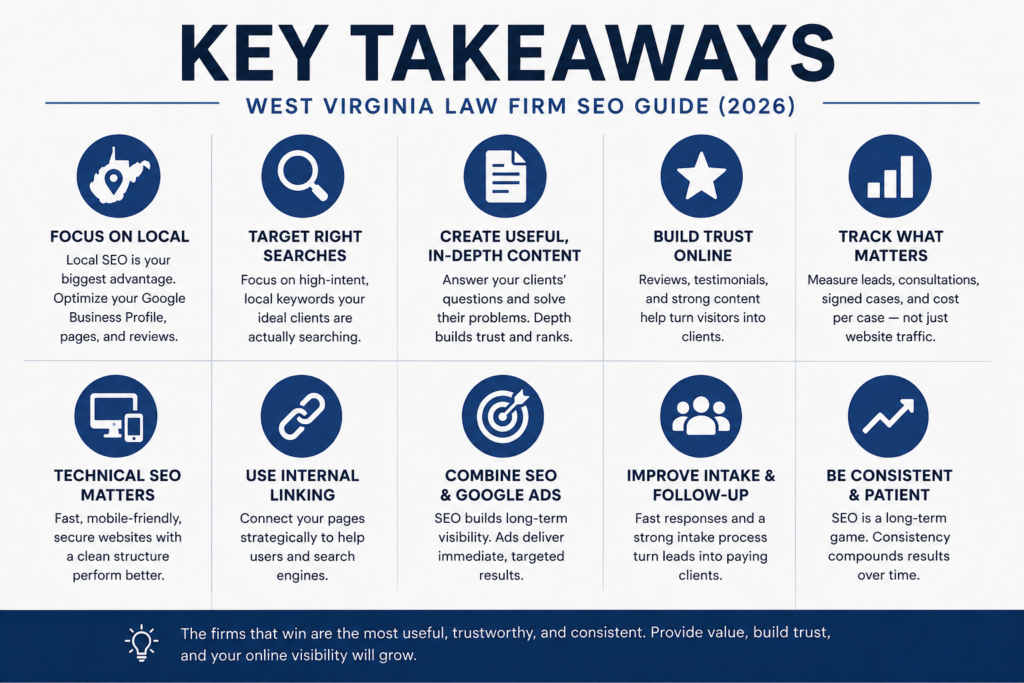
    WV law firm SEO is about more than rankings. It is about building a reliable path from search visibility to client inquiries. The firms that win are the ones that explain clearly, show up locally, track results, and improve over time.

  • West Virginia Law Firm Marketing: What Actually Works for Small Firms

    Marketing a small law firm in West Virginia does not have to be complicated. The goal is simple: be visible, be trusted, and make it easy for the right potential clients to contact you.

    The challenge is that many firms spend money on marketing without a clear system. They buy ads, create a website, list themselves in directories, or post occasionally online, but they do not know what is actually producing clients.

    Start with trust

    Legal services are personal. People often search for a lawyer during stressful moments. They want competence, clarity, and confidence.

    A law firm website should quickly answer basic questions: who you help, what problems you handle, where you practice, how to contact you, and what the next step looks like.

    Local visibility matters

    For many small firms, local search is one of the most important channels. People search for lawyers near them, lawyers in their county, or lawyers who handle a specific issue in West Virginia.

    A strong Google Business Profile, accurate contact information, local citations, and consistent reviews can all help a firm appear more credible and findable.

    Referrals still matter

    Referrals remain powerful in legal marketing. But referrals and SEO should not be viewed as opposites. A potential client who hears about a lawyer may still search for that lawyer online before making contact.

    In that sense, a website supports referrals. It confirms credibility.

    Content helps people understand

    Useful legal content can help potential clients understand their situation before they call. This does not mean giving legal advice for every case. It means explaining common issues in plain language.

    Examples include FAQs, practice-area explainers, local legal process pages, and articles that answer common client questions.

    Avoid vague marketing

    Generic marketing is easy to ignore. A page that says “experienced attorney serving clients with dedication” does not say enough. Better marketing is specific.

    What practice areas does the firm handle? What counties does it serve? What kinds of problems does it solve? What should a client expect after contacting the firm?

    Track the client journey

    Small firms should track how people move from search to website visit to call to consultation to signed client. Even simple tracking can reveal major problems.

    If people are visiting the website but not calling, the issue may be messaging or calls to action. If people call but do not schedule, the issue may be intake. If consultations do not become clients, the issue may be fit, trust, or follow-up.

    Where SEO fits

    SEO helps connect a firm with people already searching for help. A focused WV law firm SEO strategy can include practice-area pages, local pages, educational articles, and technical improvements that make the site easier for search engines to understand.

    What actually works

    The best marketing systems usually combine several basics: a clear website, strong local search presence, helpful content, referral relationships, reviews, and consistent tracking.

    None of these pieces has to be flashy. They just have to work together.

    Final thought

    West Virginia law firm marketing should be practical. Build trust. Be findable. Answer real questions. Track what happens. Then improve the system over time.

  • Google Ads vs SEO for WV Lawyers: Which Should Come First?

    For West Virginia lawyers, one of the most common marketing questions is whether to invest in Google Ads or SEO first. Both can work. Both can fail. The right answer depends on the firm’s goals, budget, market, and timeline.

    The simplest way to think about it is this: Google Ads can create faster visibility. SEO can create longer-term visibility.

    What Google Ads does well

    Google Ads can place a law firm near the top of search results quickly. That matters when a firm needs immediate leads or wants to test demand in a specific practice area.

    Paid search can be especially useful for urgent legal needs, competitive practice areas, or new firms that do not yet have organic visibility. If someone searches for a lawyer and sees your ad at the right time, that click may become a consultation.

    The downside of Google Ads

    The downside is cost. Legal clicks can be expensive, and the firm pays whether the visitor becomes a client or not. If intake is weak, paid ads can burn money quickly.

    Google Ads also stop when the budget stops. The visibility is rented. That does not make it bad, but it means the firm needs a clear plan and strong tracking.

    What SEO does well

    SEO helps a law firm build organic visibility in search results. Instead of paying for every click, the firm creates pages that can be found over time.

    Good SEO can help with practice-area searches, local searches, question-based searches, and brand credibility. A well-built website can become a long-term asset.

    The downside of SEO

    SEO usually takes time. A new page may not rank immediately. A new website may need months of consistent work before it gains traction.

    SEO also requires quality. Thin, generic legal content is not enough. The firm needs useful pages, clear structure, local relevance, and trustworthy information.

    Which should come first?

    If the firm needs leads immediately, Google Ads may come first. If the firm is building a durable long-term presence, SEO should begin as early as possible.

    In many cases, the best answer is both: use paid ads carefully for short-term lead flow while building SEO in the background.

    Use paid ads to learn

    Paid ads can also teach a firm which keywords and practice areas produce real inquiries. Those insights can then guide SEO content.

    For example, if ads around a specific legal issue produce strong consultations, the firm may decide to create a full organic content cluster around that issue.

    Use SEO to compound

    SEO compounds because useful content can keep working. A strong practice-area page, local landing page, or legal explainer may continue attracting visitors long after it is published.

    That is why a firm should not wait too long to build its organic foundation.

    Do not ignore tracking

    Whether a firm uses Google Ads, SEO, or both, tracking matters. The firm should know which channel produced the lead, whether the lead scheduled a consultation, whether the consultation happened, and whether the person became a client.

    The WV angle

    West Virginia is not the same as New York, Los Angeles, or Philadelphia. Search volume may be smaller, but local intent can be meaningful. A focused WV law firm SEO strategy can help a firm compete where geography, trust, and local relevance matter.

    Final thought

    Google Ads can help a firm get attention now. SEO can help a firm build authority over time. The smartest firms understand the difference and use each channel for the right job.

  • How Much Should a West Virginia Law Firm Spend on Marketing?

    There is no single correct marketing budget for every law firm. A solo lawyer in a small West Virginia town has different needs than a growing personal injury firm in a competitive market. But every firm should have a budget, a plan, and a way to measure whether the money is working.

    The biggest mistake is not spending too little or too much. The biggest mistake is spending without tracking.

    Start with the firm’s goal

    A law firm’s marketing budget should match its business goal. Is the firm trying to maintain a steady flow of clients? Grow into a new practice area? Compete in a high-value category? Build long-term search visibility?

    A maintenance budget looks different from a growth budget. A firm that only needs a few new matters each month may not need aggressive paid advertising. A firm trying to dominate a practice area may need consistent investment in content, local SEO, website improvements, and lead tracking.

    Typical budget categories

    Most law firm marketing budgets include some combination of the following:

    • Website design and maintenance
    • Search engine optimization
    • Google Business Profile optimization
    • Content writing
    • Google Ads or other paid advertising
    • Directory listings
    • Call tracking and intake software
    • CRM or case management tools
    • Review generation and reputation management

    The right mix depends on the firm’s practice area, geography, and growth goals.

    Solo and small firm budget thinking

    A solo lawyer should usually start with the basics: a clean website, accurate local listings, a strong Google Business Profile, and content that explains the firm’s services clearly.

    For small firms, the next step is usually measurement. The firm should know how many calls and form submissions come from the website, which pages produce leads, and how many inquiries become consultations.

    Without those numbers, the firm is guessing.

    SEO vs paid advertising

    Paid ads can bring faster visibility, but the cost can rise quickly. SEO takes longer, but strong pages can continue producing visibility after the initial work is done.

    For many West Virginia law firms, the best approach is a combination: use paid ads carefully where immediate visibility matters, while building organic search assets for the long term.

    Do not forget intake

    A marketing budget should not stop at getting clicks. If the phone is not answered, forms are not followed up on, or consultations are not tracked, marketing dollars leak out of the business.

    That is why a serious budget should include intake systems. Even a simple spreadsheet is better than nothing. Over time, a firm may need a CRM, call tracking, or legal intake software.

    How much should a firm spend?

    Instead of starting with a fixed number, start with a business question: how many new signed clients does the firm need each month?

    Then work backward. How many leads are needed? How many consultations? What is the average value of a signed client? What is the maximum cost per signed client that still makes financial sense?

    This is how marketing becomes an investment instead of a guess.

    Where WV law firms should focus first

    For many firms, the best first investments are local visibility, content, and intake tracking. A clear website and strong local SEO foundation can help the firm get found by people already searching for legal help.

    That is where WV law firm SEO becomes important. It is not just about ranking for broad keywords. It is about showing up for the specific legal problems and local searches that matter to the firm.

    Final thought

    A law firm marketing budget should be tied to outcomes. Spend enough to be visible, but track enough to know what works. The firms that win are not always the firms that spend the most. They are often the firms that understand their numbers.

  • The 5 Metrics Every Law Firm Must Track Before Spending More on Marketing

    Before a law firm spends more money on marketing, it should understand what is already happening. More traffic is not always the answer. More leads are not always the answer. Sometimes the problem is intake. Sometimes the problem is follow-up. Sometimes the firm is getting attention but not converting that attention into consultations or signed clients.

    That is why every law firm needs a simple marketing scorecard. You do not need a complicated analytics system to start. You need a few numbers that tell you whether your marketing is creating real business.

    1. Leads by source

    The first metric is simple: where did the lead come from?

    Every phone call, form submission, email inquiry, chat message, and referral should be tied to a source. Common sources include Google organic search, Google Ads, referrals, social media, Avvo, Justia, local directories, and direct website visits.

    If a firm does not track source, it cannot know which marketing channels are working. A law firm may think referrals are driving most business when Google is quietly becoming more important. Or it may think SEO is working when the actual signed cases are coming from paid ads.

    2. Consultation requests

    Not every lead is equal. Some people are asking a basic question. Some are not a fit. Some are ready to hire.

    A consultation request is more meaningful than a casual website visit because it shows stronger intent. Law firms should track how many leads turn into scheduled consultations. This helps separate general interest from real opportunity.

    3. Show rate

    A scheduled consultation is not the same as a completed consultation. Some potential clients do not show up. Some cancel. Some never respond after the initial call.

    The show rate tells the firm how many scheduled consultations actually happen. If this number is low, the problem may not be marketing. It may be confirmation emails, reminder texts, intake scripts, or the speed of follow-up.

    4. Signed client rate

    The signed client rate is one of the most important numbers in law firm marketing. It shows how many consultations become paying clients.

    If a firm gets many consultations but few signed clients, the issue could be pricing, case fit, trust, communication, or follow-up. Marketing may be doing its job, but the sales and intake process may need work.

    5. Revenue by marketing source

    The most useful metric is not just leads. It is revenue by source. A channel that produces ten low-value leads may be less valuable than a channel that produces two strong cases.

    For example, organic search might bring fewer leads than paid advertising, but those leads may cost less and convert better over time. A proper system should eventually connect source, client, matter type, and revenue.

    Why these metrics matter

    Law firm marketing often fails because the firm looks at surface-level numbers. Website visits feel good. Impressions feel promising. Clicks are useful. But the real question is whether the marketing is producing consultations, clients, and revenue.

    That is especially important for small firms with limited budgets. A solo lawyer or small West Virginia firm cannot afford to waste money on campaigns that produce noise but no business.

    How this connects to SEO

    Search engine optimization is powerful because it can build long-term visibility. But SEO should still be measured. If your firm invests in WV law firm SEO, you should know which pages are bringing in traffic, which searches are creating leads, and which leads are becoming clients.

    The goal is not just to rank. The goal is to be found by the right people at the right time.

    Final thought

    Before spending more on marketing, build a basic measurement system. Track leads by source, consultation requests, show rate, signed client rate, and revenue by source. Once those numbers are visible, better decisions become possible.